|
|
CIRCE
|
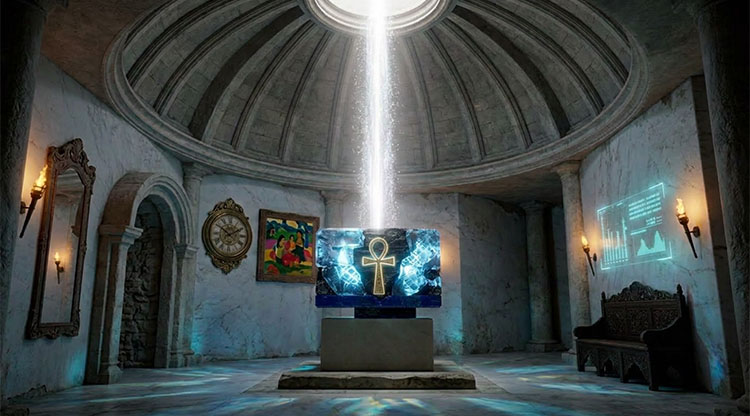

Circe stands among the earliest and most dangerous anomalies in recorded existence—a daughter of the Titan Atlas and Daphne, a disavowed Emissary whose name has been quietly erased from most sanctioned histories. Born alongside her twin sister Calyso, Circe represents one of the first unions between deity and Emissary, a convergence that produced something neither lineage fully understands nor entirely trusts. Her power is rooted in the Continuance, specifically the elusive and volatile Violet Continuance, which she has mastered with unnerving precision. Where others draw from it cautiously, Circe reshapes it—bending form, identity, and matter into violent transformations the Architects deem unnatural, if not outright profane. To Circe, however, transformation is truth. Permanence is the illusion. Despite her defiance, she is deeply fascinated by the Architects—their rigid perception of time, their structured manipulation of the Via, and their belief in order. Where they see timelines, she sees opportunity. Where they enforce boundaries, she negotiates exceptions. Circe has long operated in the spaces between factions, striking bargains with deities, Architects, and even the Absence when it serves her purposes. Her influence threads through pivotal moments in hidden history. She played a critical role in the creation of both the M’naads and the Paladins, working alongside Architects and Emissaries at Avalon using the ancient Prismatic Formula. These contributions earned her a dangerous privilege: sanctioned movement through time itself. A privilege she abused often enough that the Architect Clea was forced to intervene, appointing Montegarr to oversee and restrict her temporal excursions. Her relationship with the Architects remains… strained. Circe has been ally and adversary in equal measure across centuries, her loyalty shifting with her curiosity. They work with her when necessary, but never without caution. In contrast, her twin sister Calyso has taken a different path—becoming the enduring lover of the ancient Architect Clea since the era immortalized in the Odyssey. Where Calyso seeks connection, Circe seeks evolution. For the past five centuries, Circe has moved through the modern world under the name Cirella Stevens, seamlessly adapting to each era she inhabits. In the present day, she operates behind an almost satirical façade: the author of a provocative self-help book titled Be What I Eat, a manifesto disguised as empowerment literature that quietly encodes principles of transformation, consumption, and identity manipulation. Regardless of the century, Circe’s presence is unmistakable. She embodies a bold, exotic, and rebellious aesthetic that mirrors her nature—uncontained, seductive, and faintly dangerous. Tall and lean with an athletic precision, she favors a striking black leather ensemble: a sleeveless corset, reinforced with tactical straps and buckles, paired with long fingerless gloves that climb her forearms. Her pale, warm-toned complexion is set against sharp cheekbones and full lips, while dark, smoky eyes and heavy black liner give her a feline, predatory allure. Her raven-black hair falls in thick, untamed waves, styled in a loose half-up fashion that suggests intention without discipline. She does not simply enter a room—she alters it.
|
###
© 2026 Michael-Evenstar. All rights reserved.
Continuum House is a work of original fiction.
All characters, events, organizations, and locations are fictional
or used fictitiously, and any resemblance to real
persons, places, or events is coincidental.